Last grand rounds of '05
...is up a The Health Care blog. Still mostly out of internet contact for a few more days, so check out the best of 2005 over there!
| Permalink
|


| Permalink
|
| Permalink
|
 My favorite essay arguing against intelligent design isn’t one of Gould’s, or Dawkins’, or Sagan’s. Rather, it’s one that has portions I disagree with, but the eloquent prose simply can’t be beat:
 "The analogy which you attempt to establish between the contrivances of human art, and the various existences of the Universe, is inadmissible. We attribute these effects to human intelligence, because we know beforehand that human intelligence is capable of producing them. Take away this knowledge, and the grounds of our reasoning will be destroyed. Our entire ignorance, therefore, of the Divine Nature leaves this analogy defective in its most essential point of comparison.These come from an 1814 essay by Percy Bysse Shelley, analyzing the claims in William Paley's Natural Theology, a text which explores arguments very similar to those used by modern-day ID advocates. So similar, in fact, that although some of the minor details have changed, Shelley's refutation of it can be easily used today.
You assert that the construction of the animal machine, the fitness of certain animals to certain situations, the connexion between the organs of perception and that which is perceived; the relation between every thing which exists, and that which tends to preserve it in its existence, imply design. It is manifest that if the eye could not see, nor the stomach digest, the human frame could not preserve its present mode of existence. It is equally certain, however, that the elements of its composition, if they did not exist in one form, must exist in another; and that the combinations which they would form, must so long as they endured, derive support for their peculiar mode of being from their fitness to the circumstances of their situation."
These textbooks seem also to have been intended to provide solace for the existentially anxious. All of them offered in one form or another the reassurance that “Geography eaches us about the earth which was made to be our home.” Earth by itself “could not be the abode of man,” advised one. “Therefore, two indispensable agents are provided—the sun and the atmosphere.” The entire vast history of the planet was summed up as the “gradual formation by which it was made ready for the reception of mankind.” The lay of the land had been thoughtfully arranged for our benefit: “As the torrid regions of the earth require the greatest amount of rain, there are the loftiest mountains, which act as huge condensers of the clouds.” Because the breezes that blew down mountainsides cooled the inhabitants below, the highest were located in the hottest pars of the world “for the same reason that you put a piece of ice into a pitcher of water in summer, rather than in winter.”Of course, these are very similar to the arguments put forth in Natural Theology and a number of other texts over the centuries, reviewed briefly here.
Another book explained that all the plants and animals that lived and died for eons did so precisely because humans, during their industrial era, would need the coal. The author observed that “the wisdom of this Plan is further recognized in the fact that the coal is found, mainly, in those parts of the earth that are best fitted for human habitation—in the United States, Great Britain, Western Europe, British America, and China.”I wonder what these same authors would say today if they were aware of our efforts to extract oil in the Gulf of Mexico, Siberia, Alaska, etc.-—not exactly the best fit areas for human habitation. This is the problem with correlating religious ideas to natural phenomena, and assigning purpose in a scientific setting. One may be able to make a theological argument outlining what God’s Plan is, but it’s not a scientific endeavor. Baynton notes this:
Design arguments…reverse such practical explanations, replacing natural causality with supernatural predestination. In doing so, useful answers that open up further questions are replaced by answers that are emotionally satisfying but intellectual and practical dead ends. After all, once you know that mountains exist because they were meant to exist, what is left to do but sit in your armchair and mediation on the wisdom of their design?And this is a big reason why scientists are so frustrated with intelligent design—it doesn’t provide us with anything useful. When ID advocate Guillermo Gonzalez was asked at his talk at the University of Northern Iowa what the practical applications of ID were; how it could be used in a practical sense to explore avenues not possible with current scientific methodology? He answered (paraphrasing) that it was "a truth that can be known, leading us to ask more questions and examine the evidence more carefully"--but that's something scientists do, anyway. And sure, who can disagree that the pursuit of truth is a noble thing? But ID is not a scientific truth. It is a religious conjecture, identical to those pointed out by Baynton. Consider, for example, Gonzalez’s thesis in “The Privileged Planet:” that habitability and observability must correlate, because God (oops, The Designer) meant for us to be able to see the magnificence of the Universe. Isn’t this just as silly, and just as arbitrary, as the idea that coal was placed in the specific spots on this earth that “were most fit for human habitation?” Additionally, how does one ascertain the motivations of this mysterious Designer—-the central tenet of The Privileged Planet and other ID writings-- without first knowing their identity; a question which Discovery Institute Senior Fellow Johnathan Witt notes here, is religion.
The details have changed, but the fundamental habits of thought at issue have not. Do we want children to learn what is currently known and, more important, what remains to be discovered, about the physics of planetary motion? Or rather should they learn that “As the earth is round, only half of it can be lighted at once. In order that both sides may be lighted, the Creator has caused the earth to rotate”?It may be, as Baynton notes, a solace to think that this is the explanation for the Earth’s rotation. It may even be a correct explanation; I’m not in a position to say. But either way, it’s a theological stance, not a scientific one.
| Permalink
|
Respect religious beliefs, but don't teach them as science
Proponents of intelligent design are working in many states to legally incorporate ID into the science curricula of public schools. On Tuesday, however, U.S. District Judge John Jones ruled that ID is not science and cannot be taught in Dover, Pa., public-school science classes. The Iowa Academy of Science agrees with this decision.
The Dover trial made it very clear that the arguments of ID are not scientific, and the basic message of ID is the same as young-earth creationism: Evolution is wrong, and a literal interpretation of Genesis explains everything we see in our world. The argument of ID that there is an "intelligent designer" behind the universe may be a good theological topic, but it has no place in science classrooms.
***
The Iowa Academy of Science and the science community, in general, respects religious belief and has no intention of diminishing religion in society. Central to the academy's mission, however, is to educate Iowa's citizenry about science. Science hasn't all the answers to questions about life on earth, but evoking a supernatural explanation, as ID advocates, will not advance our understanding of our physical world.
ID proponents press school districts to provide "equal time" and to "teach the controversy." Even on the campuses of Iowa's universities, discussions are being held on whether or how to teach ID.
Americans place a high value on fairness, and providing equal time for ID seems only fair, right? The Iowa Academy of Science has high regard and respect for the value placed on fairness; however, it is not that simple. ID proponents would have science teachers recognize a deity "behind the universe." If so, to be fair (and constitutional), teachers would have to include discussions about the many different deities revered by human societies. Our government cannot give preference to any one religion, including Christianity.
What many people do not understand is that within the science community, there is no controversy about evolution. The controversy is among the general public.
| Permalink
|
Just wait until Pat Robertson gets a load of this.If only national reporters covered science with his combination of humor and a no-holds-barred bullshit detector...I can dream, I guess.If you thought the election and the removal of that inflamed boil on democracy that was the Dover school board had doomed Dover to an eternity of perdition, filled with pain and suffering and the lamentations of the damned echoing over a Muzak-like soundtrack of Britney, Clay and other soulless pap, you ain't seen nothing yet.
You should take a few minutes - well, an hour or so - to read federal Judge John E. Jones III's ruling in the case of Kitzmiller v. Dover.
If the election convinced Robertson that Dover will fall into the hands of Satan, he will most certainly interpret the judge's ruling as a sign that Armageddon is truly upon us.
It was telling that, moments after Jones' ruling landed, Dover was beset upon by a plague of locusts, poisonous toads rained from the sky and some obsequious jerk from Fox News arrived in town to interview residents about their role in the coming apocalypse.
OK, none of that happened, except for the Fox News thing.
Dover is once again driving the national SUV down the highway to hell by, as Robertson has famously said, turning its back on God. And now the judge is providing the map.
| Permalink
|
| Permalink
|
Although proponents of the IDM (Intelligent Design movement) occasionally suggest that the designer could be a space alien or a time-traveling cell biologist, no serious alternative to God as the designer has been proposed by members of the IDM, including Defendant's expert witnesses.He discussed this at length, clearly connecting the dots between the Discovery Institute, the Wedge Document, Pandas and People, right up to the Thomas More law center and the Dover school board. On page 31,
A "hypothetical reasonable observer," adult or child, who is "aware of the history and context of the community and forum" is also presumed to know that ID is a form of creationism...The evidence at trial demonstrates that ID is nothing less than the progeny of creationism. What is likely the strongest evidence supporting the finding of ID's creationist nature is the history and historical pedigree of the book to which students in Dover's ninth grade biology class are referred, Pandas. Pandas is published by an organization called FTE, as noted, whose articles of incorporation and filings with the Internal Revenue Service describe it as a religious, Christian organization. Pandas was written by Dean Kenyon and Percival Davis, both acknowledged creationists, and Nancy Pearcey, a Young Earth Creationist, contributed to the work.The Pandas book was definitely a slam-dunk, though many other factors clearly contributed as well: the history of the decision by the Dover board to have their teachers announce the disclaimer, and the adoption of the Pandas book as an "alternative" text (and the lies that were told about it during the trial); the Wedge document; Behe's arrogant testimony (dissected further at Pharyngula); and the overwhelming view from the community that ID was indeed religious, as measured by opinion letters in the local newspapers. The latter is something that could be very important in any future trials of this nature: even if the proponents are careful to say that the designer in ID can be "a time-travelling cell bioloist" or whatever, the community is going to be more vocal in their belief that ID is a religious idea, and the designer is God.
As Plaintiffs meticulously and effectively presented to the Court, Pandas went through many drafts, several of which were completed prior to and some after the Supreme Court's decision in Edwards, which held that the Constitution forbids teaching creationism as science. By comparing the pre and post Edwards drafts of Pandas, three astonishing points emerge: (1) the definition for creation science in early drafts is identical to the definition of ID; (2) cognates of the word creation, which appeared approximately 150 times were deliberately and systematically replaced with the phrase ID; (3) the changes occurred shortly after the Supreme Court held that creation science is religious and cannot be taught in public school science classes in Edwards.
| Permalink
|
| Permalink
|
The much-awaited decision in the Kitzmiller et al. v. Dover Area School District is now available.
The 139 page document finds for the plaintiffs.
Judge Jones finds that “intelligent design” is not science. The DASD ID policy violates both purpose and effect prongs of the Lemon test, and also violates the Pennsylvania constitution.
| Permalink
|
| Permalink
|
 Progeria, (officially, "Hutchinson-Gilford Progeria Syndrome"), is a rare fatal disease that makes the victim appear, as the name suggests, prematurely old. Although these children are born looking healthy, onset of the disease occurs around 12-24 months, affecting about 1 out of 4 million children. Symptoms include growth failure, hair loss, and other diseases of aging: atherosclerosis and stroke, arthritis, hip dislocation, aged-looking skin. Most children die of heart disease by the age of 13; life expectancy averages between 8-21 years. (A marked contrast to the story of Brooke Greenberg, a 12-year-old who still looks like an infant).
One study found that some of the lamins turn up in the wrong place—too tightly linked to the membranes of the nuclear envelope to participate properly in key stages of cell replication.It's often said that funding for research is unbalanced. Why do we spend so much money on a disease that only affects a relatively few people? Why isn't more money spent on heart disease and stroke, leading killers in the U.S., for example? If heart disease causes, say, a third of all deaths, shouldn't it get a third of the research dollars? This case shows why it shouldn't be quite that simple. Progeria is a rare disease, affecting only a handful of children in this country--but research in this area may lead not only to treatment and/or prevention of progeria, but also to a better understanding of the molecular mechanisms that cause us all to age. You simply don't know where the next brilliant insight is going to come from, whether it be specific disease-related research, or your morning breakfast cereal.
The researchers said this would disrupt DNA replication, and be a likely factor in the rapid march of cells toward premature “senescence,” a cellular version of aging. Whether similar missteps and miscues by nuclear lamins are part of normal human aging is the question that draws researchers onward, said Goldman. But the findings are consistent with a widespread belief among biologists that a key cause of ordinary aging is damage to DNA and mistakes in gene replication, two interrelated problems.
Another study found that the most common type of mutant lamin re-organizes regions of chromosomes that are key in controlling gene expression. These portions of chromosomes, known as heterochromatic regions, are kept inactive for various reasons; for example, one of the two female X chromosomes is deactivated in this fashion in order to avoid having them duplicate their work.
One of the hallmarks of the X chromosome heterochromatic region is that it is linked to molecules known as methylated histones. But the researchers found that in a girl with the progeria syndrome, the quantities of these molecules and of an enzyme required to form them were abnormally low.
| Permalink
|
 Time names Bono, Bill and Melinda Gates Persons of Year
 Bono is a co-founder of the DATA (Debt, AIDS, Trade, Africa) organization, which fights poverty and HIV in the developing world. From that organization was spawned the ONE Campaign to Make Poverty History.
"It has been a great year for global health to get more visibility," Bill Gates said Friday. "The more people know about it, the more they want to act."
The magazine said that while sudden disasters grab the headlines, other tragedies unfold daily.
"And who is proving most effective in figuring out how to eradicate those calamities? In different ways, it is Bill and Melinda Gates, co-founders of the world's wealthiest charitable foundation, and Bono, the Irish rocker who has made debt reduction sexy," Time's managing editor Jim Kelly writes.
In January, the Bill and Melinda Gates Foundation committed $750 million to improving access to child immunizations, accelerating introduction of new vaccines and strengthening vaccine delivery systems.
The foundation focuses on education, global health, improving public libraries and supporting at-risk families, according to its Web site.
| Permalink
|

| Permalink
|
 Infection is a complicated process. Every day, we're all carrying organisms that have the potential to kill someone. A recent article in the Journal of Infectious Diseases, for example, found that just under a third of us are colonized with Staphylococcus aureus, a leading cause of skin and soft tissue infections. From our noses, to our mouth, to our gut and elsewhere, we are literally teeming with organisms--so much so that, by the numbers, the cells in our body are more bacterial than human. But generally, we don't get sick. When epidemiologists investigate infectious disease, we consider a number of factors: the genetics of the pathogenic organism; the genetics of the host; environmental and cultural factors; host nutritional status; host immune status; and a plethora of other specifics which may affect development of disease. Still, when we discuss host genetics, we've mostly been looking at nuclear genes: those on our 23 pairs of chromosomes. An interesting study out in The Lancet today suggests that view is too narrow.
| Permalink
|
 Avian influenza suspected in Malawi
Malawi dispatched blood and tissue samples to neighboring South Africa on Friday to be tested for avian influenza after thousands of migratory birds were found dead on a hill in the central Ntchisi district.
Agriculture officials expressed alarm after local villagers started scooping up the dead fork-tailed drongos -- known locally as namzenze -- to eat earlier this week in the district about 200km east of the capital, Lilongwe.
"Someone alerted police that people are feasting on mysterious manna from heaven," said Wilfred Lipita, director of livestock and animal health in the Ministr of Agriculture and Food Security. "We sent officials to caution the people not to eat them, since they may have the avian flu which has proved deadly to humans in other countries."
| Permalink
|
The Koufax Awards are held annually to honor the best of left-leaning bloggers. A "Sandy" will be awarded based on reader votes in each of a number of categories. It is like the Oscars for lefty bloggers, except that we do not allow overly long, overly sentimental speeches by the winners.
***
What is the purpose of the Awards?
There are three purposes of the Koufax Awards. First, as I wrote last year:
At its core, the Koufax Awards are meant to be an opportunity to say nice things about your favorite bloggers and to provide a bit of recognition for the folks who provide us with information, insight, and entertainment usually for little or no renumeration. The awards are supposed to be fun for us and fun for you.
The second purpose of the awards is to provide some exposure for blogs that you may have overlooked for some reason or another. There are lots of good blogs out there (more everyday) and no one can keep track of them all. We hope to call your attention to new blogs or blogs that deserve a chance to capture your attention. That is the reason for our policy of providing a link to every blog mentioned in the nomination process (despite the fact that assembling such links is an incredible amount of work). Please use those links to visit the blogs you have not previously read. You will not often regret it.
The most important purpose of the awards is to help build a sense of community between and among lefty bloggers and readers of lefty blogs. The awards provide an opportunity to say something nice about bloggers you like and to have something nice said about you. Please try not to take the idea of winning and losing too seriously. The primary rules of the contest are be nice and have fun.
| Permalink
|
 I've been meaning to blog this paper discussing evidence of louse-transmitted disease in corpses unearthed from Napoleon's army for a few days now, but haven't had the time to sit down with it. Now afarensis has saved me the work.
I will also be the first to admit that I have no idea how the DNA got into the pulp cavity in the first place...
| Permalink
|
 I love these historical analyses of disease--real, or fictional. One historical event that has been the subject of much speculation over the decades has been the Plague of Athens, a mysterious outbreak that is thought to have changed the direction of the Peloponnesian War, and for which the cause still remains uncertain:
[2] As a rule, however, there was no ostensible cause; but people in good health were all of a sudden attacked by violent heats in the head, and redness and inflammation in the eyes, the inward parts, such as the throat or tongue, becoming bloody and emitting an unnatural and fetid breath.This plague has been attributed to bubonic plague, toxic shock syndrome and/or necrotizing fasciitis due to Streptococcus pyogenes or Staphylococcus aureus, Salmonella, yellow fever, malaria, Ebola, influenza, and smallpox, to name just a few. Typhus seems to fit the description best, but it's likely that a cause will never be known with certainty.
[3] These symptoms were followed by sneezing and hoarseness, after which the pain soon reached the chest, and produced a hard cough. When it fixed in the stomach, it upset it; and discharges of bile of every kind named by physicians ensued, accompanied by very great distress.
[4] In most cases also an ineffectual retching followed, producing violent spasms, which in some cases ceased soon after, in others much later.
[5] Externally the body was not very hot to the touch, nor pale in its appearance, but reddish, livid, and breaking out into small pustules and ulcers. But internally it burned so that the patient could not bear to have on him clothing or linen even of the very lightest description; or indeed to be otherwise than stark naked. What they would have liked best would have been to throw themselves into cold water; as indeed was done by some of the neglected sick, who plunged into the rain-tanks in their agonies of unquenchable thirst; though it made no difference whether they drank little or much.
[6] Besides this, the miserable feeling of not being able to rest or sleep never ceased to torment them. The body meanwhile did not waste away so long as the distemper was at its height, but held out to a marvel against its ravages; so that when they succumbed, as in most cases, on the seventh or eighth day to the internal inflammation, they had still some strength in them. But if they passed this stage, and the disease descended further into the bowels, inducing a violent ulceration there accompanied by severe diarrhea, this brought on a weakness which was generally fatal.
[7] For the disorder first settled in the head, ran its course from thence through the whole of the body, and even where it did not prove mortal, it still left its mark on the extremities;
[8] for it settled in the privy parts, the fingers and the toes, and many escaped with the loss of these, some too with that of their eyes. Others again were seized with an entire loss of memory on their first recovery, and did not know either themselves or their friends.
In the summer of 1485, a rapidly fatal infectious fever struck England: "A newe Kynde of sickness came through the whole region, which was so sore, so peynfull, and sharp, that the lyke was never harde of to any mannes rememberance before that tyme."(For the record, the authors suggest a rodent-borne virus, such as a hantavirus, as a potential causal agent.)
Sudor Anglicus, later known as the English sweating sickness, was characterized by sudden headaches, myalgia, fever, profuse sweating, and dyspnea. Four additional epidemics were reported in the summers of 1508, 1517, 1528, and 1551, after which the disease abruptly disappeared. Contemporary observers distinguished the condition from plague, malaria, and typhus. Later suggestions included influenza, food poisoning, an arbovirus, and an enterovirus as possible causes.
Macbeth's descent into madness often elicits psychological interpretations, but he experienced neurologic and cognitive deterioration as well. This brings into question whether a psychiatric disorder alone could fully account for his condition. Any patient today, particularly one from Scotland, presenting with a similar rapid decline in neurologic, psychiatric, and cognitive function, accompanied (as in Macbeth's case) by involuntary movements, hallucinations, and insomnia, would require an evaluation for variant Creutzfeldt-Jakob disease.They even have a whole table dissecting the passage, sign or symptom described, and prion diseases that share these symptoms. Does it get any better than this?
Although we contend that Macbeth's presentation is compatible with a spongiform encephalopathy, no evidence corroborates that this is what Shakespeare intended. Nevertheless, Shakespeare showed an uncannily prescient understanding of prion disease transmission via exposure to neural tissues: "[Once], when the brains were out, the man would die / And there an end; but now they rise again / With twenty mortal murders on their crowns" (3.4.78–80). Conceivably, Macbeth was exposed to infectious prions during an early encounter with the weird sisters, whose necromantic brews contained a variety of human and animal organs. Proclaiming, "Round about the cauldron go / In the poison'd entrails throw," (4.1. 4–5), they added, for example, a human nose and liver tissues that are capable of carrying infectious prions. It is not clear that anyone consumed the witches' brews, but if Macbeth had, that could explain the exposure. Furthermore, Shakespeare foreshadowed current culinary controversies in prion disease epidemiology by warning his audiences to "eat our meal in fear" (3.2.17) until the time when "we may again / Give to our tables meat" (3.6.33–34). (A character in Twelfth Night declares "I am a great eater of beef, and I believe that does harm to my wit" [1.3.85–86]).
| Permalink
|
Early reports of great ape mortalities from local people in the Cuvette-Ouest region of the Congo Republic are currently being investigated by a wildlife health team including Dr Alain Ondzie of WCS in coordination with government authorities and researchers in the area. If carcasses can be found, samples will be sent for diagnostic work to CIRMF/IRD network partners. The RoC Ministry of Health is mobilizing community outreach efforts while the wildlife investigation is underway.Ebola in African primates has been a real problem since about 2001. While, as I mentioned previously, human cases of the disease have been fairly minimal, primate researchers estimate that thousands of gorillas have died in the past decade from Ebola during outbreaks in Gabon and Côte d'Ivoire. In Gabon, gorilla sightings (or other evidence of their presence, such as dung and trails) decreased by 50% in a few short years; chimpanzee sightings decreased by 88%. Eight groups of gorillas that had been monitored by primatologists for 10 years disappeared completely between October 2002 and January 2003. Several gorilla carcasses that were found were positive for Ebola, suggesting this played a role in the population decrease.
This is in the same area where there was an Ebola outbreak earlier in 2005.
| Permalink
|
 Staphylococcus aureus. The name means, literally, "golden grape clusters." Upon staining, these round bacteria are visualized in clumps that resemble bunches of grapes. Every microbiology student is familiar with the most notorious member of the Staphylococcus species, S. aureus, which often produces a distinct yellow pigment when grown on agar plates containing blood. This bacterium itself causes a wide range of illnesses, ranging from food poisoning to deadly skin infections. Of great concern is the fact that strains that resist a number of antibiotics--including methicillin--have been increasingly isolated no only in hospital settings, but also in the community. Vancomycin-resistant strains have also been isolated, but are not yet widespread.
 It was recognized almost 25 years ago that the S. aureus yellow pigment consists of a number of carotenoids, similar to those produced in carrots and other fruits and vegetables. Studies of these carotenoid pigments have revealed their free-radical scavenging properties, protecting cells and tissues from the damaging effects of free radicals and singlet oxygen. (In other words, they’re antioxidants). Interestingly, one mechanism by which phagocytic cells of the host immune system destroy pathogenic invaders is via release of reactive oxygen species. Do these bacterial carotenoids protect S. aureus against damage initiated by the host immune system?
| Permalink
|
The problem is that most people ASSUME that a woman cannot be a good mother and a good scientist. So at work we always feel we have to prove ourselves and do extra so people don’t say “see, she can’t be serious about science because she is a mother”. Then women who do need to take some leave or some time to breastfeed or need to leave work to pick up a sick kid worry that this is going to lead their colleagues to assume they have lost their committment to science. The other side of the pressure and stress is caused by the very large number of people who assume that only a SAHM [stay-at-home mom] can be a good mother, and a career oriented woman must be some kind of neglectful mother who is having her kids raised by strangers.So, yeah, there's this too--guilt from all sides. You're never good enough as a scientist because you have a life away from the lab. You're never good enough as a mother because you have a life away from the kids. Is this just our paranoia, or does it really represent what people think? Do people really *say* this to us? Rarely--but it does happen. More often, I'll read it somewhere: a comment from a scientist about other scientists with families, and how their priorities aren't in line (or, one of the more overtly insulting lines I mentioned above). Or I'll see or hear a similar comment from a SAHM who is sure I'm screwing up my kids' psyches by having a demanding career.

| Permalink
|
 I'm sure some of you paid attention to the goings-on in Cobb county, Georgia, earlier this year. To sum up, evolution-deniers had placed the infamous "evolution is a theory, not a fact" disclaimer sticker on biology textbooks in the district. Other parents sued to have them removed. In January, U.S. District Judge Clarence Cooper said that the sticker violated the Establishment Clause of the First Amendment--bye-bye stickers. The ruling was appealed, and the hearing for that appeal is scheduled to be held later this week.
| Permalink
|
 As I've mentioned a bunch of times now, I work with the Center for Emerging Infectious Diseases here at the U of Iowa. Our primary focus is zoonotic diseases (diseases which are transmitted between species), and being in an agricultural state, we have a special interest in pathogens of agriculture. A new analysis by Mark Woolhouse and Sonya Gowtage-Sequeria in the journal Emerging Infectious Diseases has taken a closer look at the origin of zoonotic diseases. By the numbers: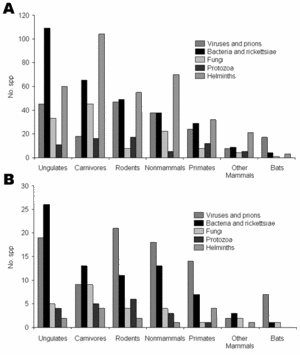
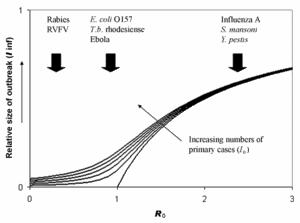
They next grouped the pathogens according to host range, and found that greater than 40% of the pathogens with the broadest host range (3 or more types of nonhuman host) were emerging or reemerging:

| Permalink
|
| Permalink
|
Although they don’t all agree on the merits of intelligent design, most members of the Muscatine School District Board of Education believe that students should know about it, and they agree that it will likely be discussed by the Board within the next two years.I wonder if she's contemplated that there are thousands of things "that people believe" that are not taught in schools, and by opening the door to one of them, you're leaving a crack for all the other nutty ideas that are out there.
Ann Hart, vice president of the Muscatine School Board, said she would not remove evolution from the school district’s curriculum, because of its scientific basis, but that students should also know about intelligent design.
“I think somewhere along the line, intelligent design should be brought up because a lot of people believe in it; and, otherwise, kids aren’t going to understand it as well as they should,” Hart said. “I don’t think we should go in-depth with it, just let kids know what it’s about and that it’s what some people believe and then go on to evolution. I believe in evolution, for sure, but we do need to let kids know this is something that people believe.”
Muscatine School Board member Clyde Evans said he would not be opposed to the teaching of intelligent design in Muscatine’s schools, and agreed that it would probably be discussed when the science curriculum was being reviewed.Ah, yes, Paley's Natural Theology...which, of course, ID isn't, according to Gonzalez et al. What's not noted is that many people believe in evolution *and* give credit to God at the same time. Earlier in the article (that I snipped out for brevity), the reporter describes evolution as an "unguided" force, but theistic evolutionists have no problem believing God played some role in how things turned out. Maybe someone should ship the school board a copy of "Finding Darwin's God" as a Christmas gift.
Evans compared the workings of the human body, universe and nature to a fine watch in their design and operation. “I think if you look at how very complicated and very sophisticated it is, there’s probably as much credit for (intelligent design) as for (evolution), and probably more,” he said.
Board member Tom Welk was also supportive of intelligent design in school curriculum, although he said he had not studied the subject to the extent that he had an exact definition of intelligent design.*Snicker* Good luck with that--even the ID supporters don't agree on an "exact definition" of it.
“Personally, I’m a believer,” he said. “We have not discussed it as a Board, but I would probably be supportive of it being taught. Of course, I’d still need an exact definition of it.”
Welk said that should intelligent design be discussed, he expected Iowan’s reactions and thoughts to be similar to the residents of Kansas.A comparison to Kansas is not a good thing, as they just received a big fat F on their science standards.
Board member Paul Brooks said he was still deciding his position on intelligent design.Hmmm, what "assessment of the creation" are your teachers now giving?? Sounds like Mr. Brooks is saying that if his teachers agree to indoctrinate kids in the specific way he agrees with, he'd be OK with it--but none o' them atheist teachers telling the young-ins that ID's hokey, now, y'hear??
“I know what I believe, but I guess my feeling is I don’t know if I want atheist people in teaching positions trying to talk about intelligent design,” he said. “If I could determine who the instructors were, that’d be different. Right now, I’m confident our teachers give students a fair assessment of the creation.”
But at least one Board member, president Jerry Lange, said he would feel uncomfortable with intelligent design in school curriculum. Lange did agree that it was likely to be an issue in the next two years.Thank you, Mr. Lange, for being the voice of reason.
Lange believed intelligent design was an attempt to put religious doctrine into schools, and while he did think it would be acceptable to introduce the idea to students as far as explaining its purpose, he would not support any significant teaching of intelligent design.
| Permalink
|
A Thai boy has become the 70th Asian to die of bird flu, authorities said on Friday, as reports warned a flu pandemic could cost the U.S. economy hundreds of billions of dollars as well as millions of lives.The news that the boy didn't have any known direct contact with birds is worrying. Hopefully this is an anomaly, or there's some unrecognized contact with birds that his family may not know about. If more of these "no known fowl contact" cases start showing up, it's really time to start battening down the hatches and preparing for the worst.
The death of the 5-year-old boy from the central province of Nakhon Nayok, 110 km (70 miles) from Bangkok, took Thailand’s bird flu death toll to 14 out of 22 known cases since the virus swept through large parts of Asia in late 2003.
It was not certain how the boy caught the virus, which usually strikes those in close contact with infected fowl or their droppings, senior health officials said. The boy, who died in hospital on Wednesday, was not known to have had direct contact with chickens, health officials said.
“We believe that the boy contracted the virus from his surroundings because, although his family does not raise chickens, there are chickens raised in his neighbourhood,” said Thawat Suntrajarn, head of the Health Ministry’s Disease Control Department.
China also reported a new case of H5N1, the fifth person in the country known to have been infected with the deadly virus. The 31-year-old woman, who lived in Heishan county of Liaoning province, has since recovered.
| Permalink
|
The developments of the past year show that the "accepted wisdom" on science isn't as quickly or as widely accepted as perhaps it once was — partly because of a skeptical political climate, and partly because the Internet provides wider access for dissenting views. Those societal challenges are sparking the rise of a new breed of scientists: media-savvy folk who aren't afraid to join the fray themselves.And this is both good and bad. They mention Gavin Schmidt of the RealClimate blog:
Schmidt and his co-bloggers get into the nitty-gritty of climate research, interacting earnestly with fans as well as foes in long strings of reference-rich commentary. It's not an approach meant to attract a mass audience or stir a political movement — and Schmidt doesn't mean it to be.But while RealClimate, as they mention, is "reference-rich" and run by experts in the field, there are also, of course, sites like that by the Discovery Institute and other creationist groups, which, to many lay people, seem to be scientific and convincing, while the experts in the field scoff. It's great that we scientists are becoming better able to take new findings and explain them directly to the public, but it's unfortunate sometimes that there's so much "background noise" with the conspiracy theorists and anti-science brigade that it becomes difficult for many people to separate the wheat from the chaff.
| Permalink
|
The official justification for shutting down the lab is that the memorandum of understanding between the governments of Indonesia and the United States, which set up NAMRU-2 in 1970, expired in 2000 and has yet to be renewed. Since 2000, however, the lab has continued its activities--which in addition to large diagnostic and surveillance programs includes training medical workers to recognize and treat H5N1-infected patients--without interruption. "From 1 January 2006," the letter dictates, "all NAMRU-2 activities will be terminated until a new M.O.U. between the Government of Indonesia and the United States Government has been signed."
The letter does not mention what concessions Indonesia aims to obtain from the U.S. But it closes by reminding health officials that every scientific article they produce in collaboration with a foreign researcher must be cleared by the ministry of health before it can be published.
| Permalink
|
| Permalink
|



|
|
|
|
|
|


